Tuesday, January 20, 2026

Latest Project

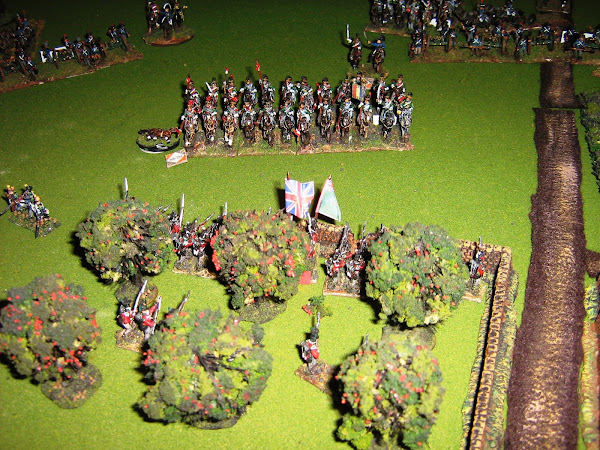
One of my favorite and most extensive collections is the one I have for the Seven Years War in 15mm. All of the figures are Old Glory. I have large contingents of Prussians, Austrians and Russians as well as units of French, Hanoverians and various German states. For many years I have used the SYW variant of General de Brigade, but I have lost my enthusiasm for those rules. I have thoroughly enjoyed the rules I developed for the Jacobite Rebellion, so I decided to adapt them to this period in 15mm. I have done a little play testing and made some adjustments accordingly. I am quite pleased with the results. I have relabeled all of my armies over the last couple of weeks. It gave me a chance to do some reorganizing of the units into more reasonable brigade sizes. I have also made command cards for all of the leaders as this is a very importand component of my rules system. I will need to add some more command figures and ADCs, but other than that I believe the project is just about complete. Here are some pictures from my latest play test.
In the pictures, the red dice are used to keep track of losses. The green dice show how many initiatives a battery needs to reload. As in Fire and Fury, units lose effectiveness as their numbers decrease. Once they reach a certain point they are removed from play. Once a brigade has lost half or more of its units (or the commander is killed or wounded), it must take a brigade morale test. On the horizon, I'd like to attempt a solo campaign. I have some ideas for how to randomly distribute the units onto a custom made map and then to use initiative rolls to add a "fog of war" effect to how they can move about.

Friday, January 9, 2026

Gaming with my Grandson

I had the rare privilege of having a wargame with my 16 year old grandson. We have "played soldiers" over the years, but we have never actually played an official wargame. He came to stay with me for a few days as he waited for a flight, so it gave us an ideal opportunity. For the game I used the European contingents from my Jacobite Rebellion collection. Three brigades of French, two of infantry and one of veteran cavalary, deployed along a ridge. Two battalions were dispatched to the extreme left under the command of an ADC to defend a bridge and a small village. On turn four, four Dutch regiments would come on the table to reinforce them. My grandson commanded these forces. I took charge of two brigades of British, one brigade of Hessians and a small brigiade of British dragoons rated as conscripts. My task was to drive the French off the ridge and to capture the bridge leading into the village. We used my home brew rules which combine mechanics from Sharp Practice, Hail Caesar/Black Powder and Regimental Fire and Fury. Each brigade is represented by a card in the playing deck. Units go in the order their cards are drawn. To get individual units to carry out actions and initiative roll is made. 2-5 allows for three actions, 6,7 allow for two, 8-10 permit one. One an unmodfied roll of 11 or 12, the brigade's turn comes to an abrupt end and the next card is drawn. Between the drawing of the cards and the initiative rolls, there is a lot of uncertainty in each turn. My grandson ready to take on his dear ol' granddad.
The initial set up. Both cavalry brigades faced off against one another on the French right flank.
The first turn saw the British advance all along the line. A bad initiative roll, however, (an 11), prevented one British brigade to do anything. Surprisingly, despite the mission assigned to hold the ridge, my grandson decided that the best defense was to go on the offensive.
The second turn saw the two cavalry forces engage in a brief but savage struggle. The conscript British dragoons were easily destroyed by the vastly superior French horsemen, but did suffer a few casualties in the process. On the other end of the table, the Hessian battery was able to do some serious damage to a French battery opposite it. This damaged battery would do more harm than good for the French cause due to two bad initiative rolls later in the game.
On turn three things heated up significantly with volleys crashing all along the line. The French fire was devestating and British and Hessian casualties were siginificant.
Turn four saw the arrival of four fresh Dutch battalions and a battery to bolster the French center. On the British right, a battery did terrible work against one of the French battalions defending the town while a highland regiment forded the river to endanger the French flank.
With the British dragoons driven from the field, the French horsemen were free to support an attack on the Britisn left. One French battalion caught to British battalions in the flank. The ensuing mele was not as devestating as my grandson had hoped, but it did see the redcoats driven back and masking their guns.
As the game drew to a close, the Hessians and French battled to a standstill. The contingent holding the village was outflanked and forced to withdraw towards their main force. The British battalions in the center had been decimated and disorganized by the disciplined volleys of the veteran French regiments. Two batteries of artillery, one French and the other Dutch, were now positioned to rain havoc on the British center. It had been a hard fought battle. The French were in solid control of the ridge line, but had lost the bridge and village. The British had suffered considerably more casualties and it was determined that was enough to give the French the victory. My grandson, aided by some very lucky dice rolls, had done a masterful job of commanding his forces. I was incredibly proud of the way he worked his way on to my flank to stiffle my attack on his center. He did remarkably well for his first official wargame. I hope there will be many more.

Monday, January 5, 2026

General de Brigade Battle 12/20/25

The tradition continues of three of my former students returning on their winter break for a wargame. This time two of my grandsons also joined us and we all enjoyed the contest. The lads had requested a Napoleonic game, so I pulled out my Peninsular War figures for the contest. A division of Spaniards held a ridge line, the bulwark of which was a church. Supporting the Spaniards to their left was a brigade of British light cavalry. A brigade of British line infantry and a battery defended a river on the extreme flank.
On the French side, four infantry brigades and a briagde of dragoons had massed for the attack. An allied brigade made up of Westphalians and Poles were on the left, two French brigades supported by a small brigade of the elite Young Guard were in the center as well as the dragoons.
The battle was a bloody one. James's Spaniards were able to hold on the right. Jude, holding the center was able to stop a determined drive by the French dragoons. His horse battery did a heroic job of keeping the French cavalrymen from breaking through. Max and Chris traded numerous volleys across the river. Chris somehow managed to charge a battalion across the bridge and destroy the RFA 9 pound battery. In the center, the three French infantry brigades suffered terrible casualties before the Young Guard were finally able to capture the church, securing a vital foothold on the ridge. The game ended in a French minor victory. Max and Chris doing battle along the rivier.
James overseeing the Splanish right flank.
Ember and Jude happy to be included.

Thursday, December 11, 2025

More Perry 28mm Austrians For Sale

I have two regiments of landwehr for sale, each of 24 figures, the Lower Austrian Landwehr (gray coats) and the Salzburg Landwehr (green coats) $65 per regiment plus $10 shipping within the Continental US or both units for $120 plus $10 shipping within the Continental US.

Friday, December 5, 2025

28 mm Perry Plastic Austrians for Sale

I have 72 painted Perry plastic Austrians for sale. 24 are in shako, 48 in helmet. $150 plus $10.00 shipping to CONTUSA

Wednesday, December 3, 2025

Rising of the Clans After Action Report

It had been quite awhile since I had a battle with my Rising of the Clans rules. I have painted up a village and used that as the center piece for the right flank of the Government forces. The scenario charged a Jacobite force to cut a road that the Government hope to use to move supplies over. Four brigades of the King's men were given the task of holding the road, allowing the desperately needed supplies to get to their destination.
Turn 1- The story of turn one was the highly effective fire of the Jacobite artillery. Mortars and cannon pounded the Government line causing casualties and disorder.
Roy Stewart is able to push his largest regiment, the Camerons of Locheil, across the river.
Turn 2- Drummond pushed his clans into an orchard. His command rolls were poor so little progress was made. One unit formed line and fired a volley, but the targeted Government regiment was protected behind a stone wall and didn't lose a man.
Colonel Stapleton marched his two elite regiments of French regulars across a bridge into a postion to apply pressure on the Government center. Legonier, commanding the Govrenment cavalry, split his command, sending two regiments under the ADC to counter Stewart's men coming across the bridge.
The Yorkshire Blues suffer more casulaties from Olgilvy's heavy guns.
Turn 3- Drummond and Cholmondeley's men exchange ineffective volleys. However, Drummond's mortars continue to batter the line, this time hitting Cholomondeley's battery.
The order in which cards are drawn can be telling. It certainly was on this turn. Stapleton's card came up and his command rolls allowed both of his regiments to form line and fire into the Government line. The carnage was terrible.
Roy Stewart was also fortunate to have his card drawn before Campbell of Montrose. His own regiment charged down the road and caught the Edinburgh Militia in a march column forcing them back into the village in great disorder. The 10th Dragoons, however, were able to countercharge later in the turn and bring the highlanders to a halt, disordering both units.
Finally, the Yorkshire Blues suffer yet another casualty and are close to breaking.
Turn 4- Drummond is finally able to launch an attack on the stone wall. While he is able to drive back two of Cholmondeley's regiments, the victory is not decisive and he loses many good men in the effort.
In the center, Wolf is able to bring fire to bear on Stapleton's Frenchmen, thinning their ranks. He suffers a setback, however, when musketry from the Atholl Brigade routs his artillery battery from the field.
On the Government right an untimely lull ocurrs in the action as all three commanders in that sector fail their command rolls.
An overview of the action in the center.
Turn 5- This turn Drummond presses his attack. Three clans clammer over the stone wall and continue to drive back the regiment facing them. Once again, it is not a decisive victory to Drummond's great dismay.
In the center, Wolf's veteran 4th Foot puts up a stout defense against the Atholl men and Stapleton's two regiments have been shredded by intense musketry. All would be looking good for Wolf except for the fact the 47th Foot, holding the right of line his line, is destroyed by the Cameron's of Locheil. The momentum of their charge is halted by a timely countercharge of the 14th Dragoons. Despite this, the situation is precarious.
Things remain fairly static on the Government right, mainly due to the inaction of Lord Olgilvy. The only newsworthy even in this region is the destruction of the Yorkshie Blues after yet another blast of cannon. By all accounts, Campbell of Montrose was rather derilect in keeping them in an exposed position for no real purpose.
Turn 6- Cholmondeley's card is drawn first. His men are only able to issue a couple of volleys with mixed results. Clan Macranald is driven from the field, but will it be enough to blunt the blow that is sure to come this turn?
Disaster strikes the Jacobite cause when Drummond tosses an "11" for his command roll. His men will remain idle for this turn. The opportunity to roll up the Government flank is quickly eluding him.
Things also go badly for the Bonnie Prince in the center. Stapleton, desperately needing to withdraw his men, rolls an "11" as well. His men will have to withstand yet more musketry without being able to respond.
General Hawley does not let this opportunity pass him by. He orders Legonier's dragoons and Wolf's 4th Foot to charge. The Atholl men are driven back and disordered. Wolf moves his reserve regiment to secure his right flank.
The dragoons under the command of the ADC sacrifice themselves by charging Roy Stewart's men. Their heroism pays off as Stewart's attack is stalled. Will it be enough?
In yet another brutal setback to the Jacobites, the ADC trying to bring up the last of the reserves to secure the victory rolls an "11". Two veteran clans will remain on the other side of the river.
Olgilvy finally presses his men across the river towards the village. In turn seven there are sure to be fireworks on this flank.