I had the rare privilege of having a wargame with my 16 year old grandson. We have "played soldiers" over the years, but we have never actually played an official wargame. He came to stay with me for a few days as he waited for a flight, so it gave us an ideal opportunity.
For the game I used the European contingents from my Jacobite Rebellion collection. Three brigades of French, two of infantry and one of veteran cavalary, deployed along a ridge. Two battalions were dispatched to the extreme left under the command of an ADC to defend a bridge and a small village. On turn four, four Dutch regiments would come on the table to reinforce them. My grandson commanded these forces.
I took charge of two brigades of British, one brigade of Hessians and a small brigiade of British dragoons rated as conscripts. My task was to drive the French off the ridge and to capture the bridge leading into the village. We used my home brew rules which combine mechanics from Sharp Practice, Hail Caesar/Black Powder and Regimental Fire and Fury. Each brigade is represented by a card in the playing deck. Units go in the order their cards are drawn. To get individual units to carry out actions and initiative roll is made. 2-5 allows for three actions, 6,7 allow for two, 8-10 permit one. One an unmodfied roll of 11 or 12, the brigade's turn comes to an abrupt end and the next card is drawn. Between the drawing of the cards and the initiative rolls, there is a lot of uncertainty in each turn.
My grandson ready to take on his dear ol' granddad.

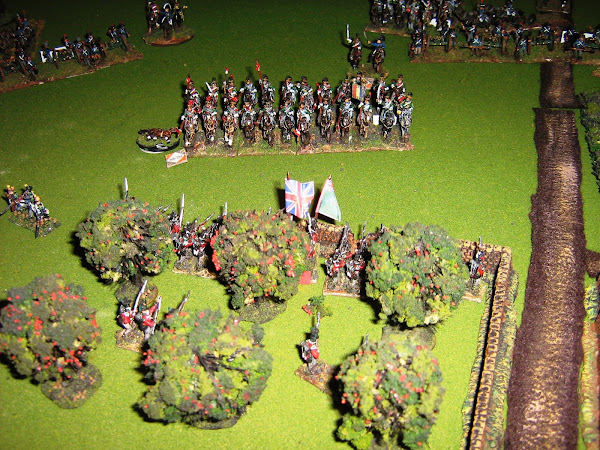
The initial set up. Both cavalry brigades faced off against one another on the French right flank.
The first turn saw the British advance all along the line. A bad initiative roll, however, (an 11), prevented one British brigade to do anything. Surprisingly, despite the mission assigned to hold the ridge, my grandson decided that the best defense was to go on the offensive.
The second turn saw the two cavalry forces engage in a brief but savage struggle. The conscript British dragoons were easily destroyed by the vastly superior French horsemen, but did suffer a few casualties in the process. On the other end of the table, the Hessian battery was able to do some serious damage to a French battery opposite it. This damaged battery would do more harm than good for the French cause due to two bad initiative rolls later in the game.
On turn three things heated up significantly with volleys crashing all along the line. The French fire was devestating and British and Hessian casualties were siginificant.
Turn four saw the arrival of four fresh Dutch battalions and a battery to bolster the French center. On the British right, a battery did terrible work against one of the French battalions defending the town while a highland regiment forded the river to endanger the French flank.
With the British dragoons driven from the field, the French horsemen were free to support an attack on the Britisn left. One French battalion caught to British battalions in the flank. The ensuing mele was not as devestating as my grandson had hoped, but it did see the redcoats driven back and masking their guns.


As the game drew to a close, the Hessians and French battled to a standstill. The contingent holding the village was outflanked and forced to withdraw towards their main force. The British battalions in the center had been decimated and disorganized by the disciplined volleys of the veteran French regiments. Two batteries of artillery, one French and the other Dutch, were now positioned to rain havoc on the British center. It had been a hard fought battle. The French were in solid control of the ridge line, but had lost the bridge and village. The British had suffered considerably more casualties and it was determined that was enough to give the French the victory. My grandson, aided by some very lucky dice rolls, had done a masterful job of commanding his forces. I was incredibly proud of the way he worked his way on to my flank to stiffle my attack on his center. He did remarkably well for his first official wargame. I hope there will be many more.