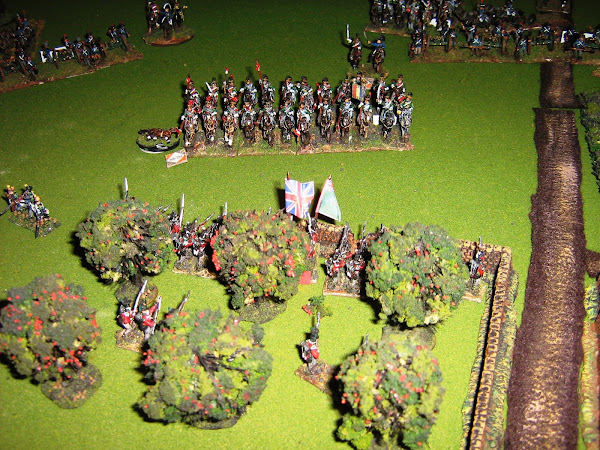

The lads continue to maneuver after our first engagement. Austria and Russia have allied against Prussia. Russian forces that have ventured into Prussian territory are now headed south to join up with Austrian forces.
In the meantime, France has joined with Prussia and are mobilizing to attack Austria from the west. This should draw away some of Austria's brigades from the north. France is also allied with Hanover. This secures France's northern border, at least, for the moment. At the same time, Hanover is at war with Prussia, so only time will tell how these political maneuvering a will pan out.
It appears that the next battles will take place along the southern border of Prussia. We have set aside The afternoon of May 16 to resolve these conflicts on the wargaming table. Interest in the campaign remains high. Stay tuned for further developments.
Wednesday, May 7, 2014


Friday, May 2, 2014
1st Campaign Game
This
was the first battle of our SYW campaign.
Prussia is facing an onslaught of enemies as all of the other powers
have united to conquer Frederick’s juggernaut.
The Russians seemed to lose their
fervor once they crossed into Prussian territory, so the first blow was
delivered by the Austrians.
In an
effort to seize the initiative, the Prussians threw three brigades of infantry
into Austrian territory. The Austrians
responded with a better balanced three brigades, one of line infantry, one of
grenadiers and one of cavalry. The
battlefield was a simple affair comprised of a major road, a couple of small
farms and a scattering of fields and woods.
There was plenty of room for maneuver on our 6’ by 4’ table.

The
Prussians led with a brigade of Hessian allies.
Though it was made up mostly of militia and conscripts, it did have a
compliment of cavalry which proved to be of critical importance. On the left flank was Manstein’s infantry
brigade and in support was Hulsen’s brigade.
The
Austrians had Puebla’s line brigade in the center, supported by Von Daun’s
grenadiers on the left and Hadik’s cavalry on the right.
Both
sides issued aggressive orders, so battle was joined straight away. Hadik’s cuirassiers and hussars were ordered
to assault Manstien’s battalions. The
Hessians charged ahead into the deployed lines of Puebla’s infantry while Von
Daun’s grenadiers attempted to move around the Prussian flank. Hulsen was able to change his brigades order
and move to ward off this threat.
The
Hessians were roughly handled by Puebla’s steady infantrymen. Two battalions of Hessian landwehr were
ripped apart by thunderous volleys and waves of canister. But as the battle was drawing to a close, a
regiment of Hessian dragoons managed to endure a blast of grapeshot and close
with the Austrian guns. They won the
mele and then, on the pursuit test, rolled low so as to have to continue the
charge. This was indeed a blessing as
Puebla’s flank was wide open. In the
following turn a battalion was caught in the flank and obliterated before the
dragoons headed back to their own lines to reform.
 |
| The regiment of Hessian hussars can be seen ready to crush the Austrian flank. All those Hessian landwehr did not perish in vain! |
Hadik’s
cavalry attempted to charge Manstein’s men,
but the overall results were dismal.
Though one Prussian battalion was destroyed, the other charges saw very
high rolls empty over half of the saddles of the brave cuirassiers, throwing
them back in defeat.
 |
| The hussars attempted to charge twice, and both times this battalion rolled very high to inflict sufficient casualties to halt the charge. |
 |
| Again, the Prussian's dice were hot, much to the dismay of the Austrian brigadier! |
 |
| Hulsen's men march to protect the right flank. |
The
battle between Von Daun and Hulsen was a stalemate, though the greater number
of casualties were inflicted by the grenadiers.
The Prussians outnumbered the Austrians, but deployed poorly and weren’t
able to take advantage of their numerical superiority.
In the
end, it was clearly a Prussian tactical victory, but a strategic victory for
the Austrians. Another brigade of
Austrian cavalry was close at hand, so the Prussians would not be able to
follow up their victory.
It was
a very fun game. The fact that it took
place within the context of a campaign added a degree of realism that had been
missing from our previous games.
Generally, casualties were moderate, but Hadik lost half of his
cuirassiers and this will surely be felt when the Prussian cavalry is
confronted down the road.
Wednesday, April 30, 2014
SYW Campaign Underway
Our SYW campaign is under way. The Prussian player rather rashly placed just about all of his counters on his western border, signaling hostile intentions towards neighboring Hanover. Seeing this, the Russian players posted their brigades along Prussia's eastern border. The Austrians were by far the most judicious power, evenly distributing counters in strategic locations throughout their realm.
Diplomats have been working feverishly on the political front. France has joined with Prussia while Austria and Russia have formed an alliance; little Hanover is standing alone, at least for the moment.
We will be fighting our first battle this Friday after school. My guess is that the opening shots will be fired in eastern Prussia; Russia is bearing down on the Prussian capital hoping to deliver a decisive blow before Frederick can develop a defense. However, Austrian forces have crossed the frontier and will stretch the Prussian resources severely.
Diplomats have been working feverishly on the political front. France has joined with Prussia while Austria and Russia have formed an alliance; little Hanover is standing alone, at least for the moment.
We will be fighting our first battle this Friday after school. My guess is that the opening shots will be fired in eastern Prussia; Russia is bearing down on the Prussian capital hoping to deliver a decisive blow before Frederick can develop a defense. However, Austrian forces have crossed the frontier and will stretch the Prussian resources severely.
Sunday, April 13, 2014
Prussians vs. Russians Part 2
I fought out two more turns this afternoon. The Russian artillery is proving to be decisive. However, two events have given the Prussian high command a glimmer of hope. On the first turn, a Prussian medium battery rolled double sixes on its bombardment of a Russian battery. The results table indicates that the stricken battery looses two additional figures, must immediately retreat 20 cm AND is low on ammo. This has left a vulnerable section in the Czar's line, being defended by only an extended line of jagers. On the second turn of the day, two Prussian hussar regiments of 24 figures each charged into two Russian cuirassier units of 18 figures each. The Prussians have won both engagements, forcing one regiment to retreat and the other has been pushed back across the small stream. Unfortunately, neither Prussian unit was able to pursue, so it will be up to two beat up landwehr regiments to try and follow up this victory.
On the negative side, losses are piling up before the Russian guns. On the Prussian right flank, literally hundreds of men have fallen in an attempt to come to grips with these dealers of death. On the left flank, a Prussian horse artillery battery was blistered with cannister as it tried to advance into position. The next two or three turns will be very important. Can the Prussians get some battalions into place to exploit their few gains? Will the Russians be able to move their limited reserves into a position to shore up these holes?
Despite the hardships dealing with the Russian artillery, this has been a fun game thus far. Depending what happens on the Russian right, things could turn dramatically.
On the negative side, losses are piling up before the Russian guns. On the Prussian right flank, literally hundreds of men have fallen in an attempt to come to grips with these dealers of death. On the left flank, a Prussian horse artillery battery was blistered with cannister as it tried to advance into position. The next two or three turns will be very important. Can the Prussians get some battalions into place to exploit their few gains? Will the Russians be able to move their limited reserves into a position to shore up these holes?
 |
| Losses mount in attempting to come to grips with the Russian guns |
 |
| My new casualty counters. I like them better than the rings I was using previously. |
 |
| Prussian landwehr moving up in support. |
 |
| The Prussian horse battery that has been severely pasted by the Russian horse battery opposite it. |
 | |
| Still another Prussian regiment trying to charge a battery. These battalions are in line which is helping to keep casualties to a minimum. |
Friday, April 11, 2014
Napoleonic Russian against Prussians and Poles
It's been awhile since my last post. I was busy finishing up a large commission of Bavarians and then painting up another brigade of Napoleonic Prussians for myself. I have finished both and I was eager to get my full Prussian corp out on the table. I allied them with my Duchy of Warsaw division for an invasion of Russian territory. I have played out the first four turns and the Prussians/Poles are having a very rough time of it. Those darn Russian guns are more than formidable! But a Prussian cavalry brigade has destroyed a brigade of Russian cossacks, threatening the Czar's right flank. But this tactic is taking time to develop, costing the lives of scores of Prussian infantry. Here are a few pictures:
I am off to dinner with my daughter, but hope to make more progress in the battle tomorrow. Thanks for taking a look. Comments are welcome and appreciated!
 |
| The Prussians in the background are having a rough go against a Russian battery. |
 |
| Here it is a regiment of dragoons that are getting a face-full of lead. |
 |
| Duchy of Warsaw troops on the extreme right flank. |
 |
| A regiment of Westphalian Landwehr supporting a battery in the middle of the line. |
 |
| A wider angle of the Prussian center |
 |
| A battery of Prussian horse artillery deployed on a hill |
 |
| Prussian hussars attempting to turn the Russian right flank. |
 |
| A large Prussian cavalry brigade at the beginning of the game. |
Sunday, March 23, 2014
Seven Years War Campaign
The idea of a campaign has floated around my head for years. In the past, attempts have been disappointing, to say the least. But I can't think of a better way to really capture the spirit of a period and generate realistic table top battles. The key to success, in my mind, is to keep the scale small enough that battles come quickly and to keep the mechanics simple.
The first thing I have done is generate a map. Five nations will be involved. The three largest will be Austria, Prussia, and Russia. Each will control a quarter of the map and will have a capital, five major cities and ten villages connected by a series of roads that will be used to move armies. Hanover and France will also take part, dividing the fourth quarter between them. They will each have a capital, three cities and five villages.
I have made counters to represent all of the brigades I have available for each country. The Prussians have the largest force with 14 brigades, the Austrians and Russians have 12, the French and Hanoverians have eight. The major powers have two supply trains each while the minor states have one. Each county has a diplomat who can travel to neighboring capitals to negotiate treaties. And then to add some "fog of war," each nation will have a number of dummy counters that will only be discovered when contacted by an opposing "real" counter.
I have also added a random events table for the end of each strategic turn. Events include such things as allowing one unit in an opposing country to "force march" one extra square, Flooding" where no rivers can be crossed the next turn, "looting" where any unit in an opposing city or village can't move the next turn.
Battles will be eight turns. As the game master, I will determine a winner. Winners will get back 50% of its losses, losers only 33%. Units can be brought back to full strength by returning to their capital and spending two turns there. It looks like will have about eight players. I'll keep the game map in my room at school and we will use our weekly meetings to plot out strategic moves and then fight battles after school as frequently as possible.
The plan is to start this Wednesday and see what happens. I am guardedly optimistic. Battles should occur quickly, but the forces involved will be small enough to make them move along quickly. Because it is a campaign, the sides will seldom be even, and the "to the last man" mentality will prove to be foolhardy.
Stay tuned for reports and updates.
The first thing I have done is generate a map. Five nations will be involved. The three largest will be Austria, Prussia, and Russia. Each will control a quarter of the map and will have a capital, five major cities and ten villages connected by a series of roads that will be used to move armies. Hanover and France will also take part, dividing the fourth quarter between them. They will each have a capital, three cities and five villages.
I have made counters to represent all of the brigades I have available for each country. The Prussians have the largest force with 14 brigades, the Austrians and Russians have 12, the French and Hanoverians have eight. The major powers have two supply trains each while the minor states have one. Each county has a diplomat who can travel to neighboring capitals to negotiate treaties. And then to add some "fog of war," each nation will have a number of dummy counters that will only be discovered when contacted by an opposing "real" counter.
I have also added a random events table for the end of each strategic turn. Events include such things as allowing one unit in an opposing country to "force march" one extra square, Flooding" where no rivers can be crossed the next turn, "looting" where any unit in an opposing city or village can't move the next turn.
Battles will be eight turns. As the game master, I will determine a winner. Winners will get back 50% of its losses, losers only 33%. Units can be brought back to full strength by returning to their capital and spending two turns there. It looks like will have about eight players. I'll keep the game map in my room at school and we will use our weekly meetings to plot out strategic moves and then fight battles after school as frequently as possible.
The plan is to start this Wednesday and see what happens. I am guardedly optimistic. Battles should occur quickly, but the forces involved will be small enough to make them move along quickly. Because it is a campaign, the sides will seldom be even, and the "to the last man" mentality will prove to be foolhardy.
Stay tuned for reports and updates.
Wednesday, March 12, 2014
More Commission Work
I finally finished up the last of my large commission of Front Rank Bavarians. My client allowed me to take a couple shots of the finished infantry, over 300 figures. The pictures didn't turn out as well as I had hoped, but they'll at least give you an idea of the amount of figures painted. He added the flags and based them. Quite impressive. They will see their first action this Saturday. I am anxious to get a report on how the hold up.
These were truly a joy to paint. I was afraid it might get a little monotonous, but he passed on one division at a time and it went quite quickly. There were four different facing colors, red, black, pink and yellow, plus a variety of colors for the linings on the lapels and collars.
 |
| Light infantry and the guard are on the right. You can see three of the six casualty figures he had me paint up in the lower right corner. |
 |
| This is the bulk of the line infantry; three divisions of two brigades each. Each brigade had two line regiments of two battalions plus a light battalion. All battalions were nine figures. That's 270 figures! |
Subscribe to:
Posts (Atom)