Monday, July 21, 2014

Napoleonic Battle of Mockern

Today we began our fourth and final week of military history in miniature.  Our battle is based on the events at Mockern during the Leipzig campaign; Russians and Prussians are assaulting the French on a wide front.
We are using General de Brigade rules pretty much as written.  There are six players per side.
These are the French on the outskirts of Mockern

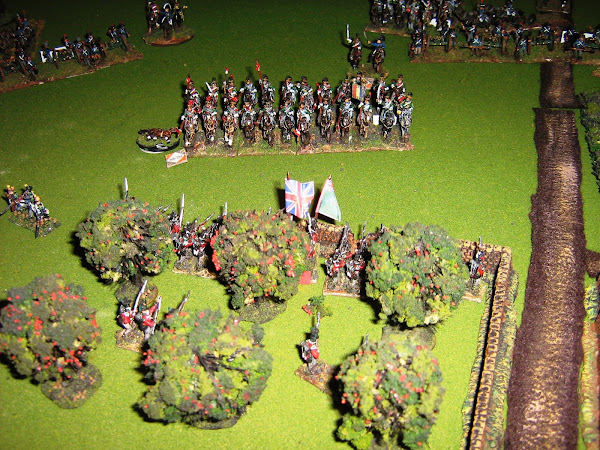
French light cavalry in the center of the table

Polish light cavalry on the extreme right flank

Duchy of Warsaw division on the right flank.


The initial orders issued were rather aggressive with lots of "assault" and "engage" markers assigned on the allied side.  The French were more content to move to solid defensive positions and then hunker down to weather the storm.  But one the first cannon roared, the young French generals threw caution to the wind and changed many of their orders to "assault."


The first moves of the game. Allies are to the left, French to the right.

Russians advance in the center.


French light cavalry attack Russian dragoons and hussars.  To their left and out of the picture French and Russian cuirassiers tangle with each other.
 As the first day drew to a close most of the allied attacks that went in were repulsed.  The French had occupied Mockern.  When Prussian regulars finally received orders to attack they were driven back with loss from the town's walls.  Prussian cavalry supported this attack on the left, but they were also thrown back by solid French squares.  The Poles, however, on the French right were being roughly handled by the effective volleys of the Russian infantry (lots of rolls of nine or higher.)  In the last action of the day, the Polish horse were able to drive off a brigade of cossacks.

The Poles have managed to seize the high ground, but they are outnumbered and terrifically outgunned.


Friday, July 18, 2014

SYW Mega Battle


This week my military history class staged an epic SYW battle that saw over 1,200 figures grapple over a a 5X12 foot table for five days.  On one side were the Austrians and their French allies.  Their task was to halt an invasion into Austrian territory.  The invaders were comprised of  Prussians and Hanoverians.  12 players and two wonderful aides pushed the miniature battalions and batteries into the fight.  Each player started with a brigade of either infantry or cavalry.  By the end of the week, about 14 additional brigades found their way to the table as reinforcements.  We used the Die Kriegskunst rules, and they served us well.  Below are some pictures and a brief account of the battle.

Day One:
The table before guns start blazing.  Austrians and allies are on the right, Prussians and Hanoverians on the left.

Hanoverian cavalry awaiting orders.

A combined brigade of Hessians on the left flank.

The Austrians, though with a defensive posture, aggressively attacked a strategic hill.

On the Austrian left flank, Prussian cavalry made life very difficult for an Austrian brigade trying to defend an important village.

Large Austrian force that spent most of the battle marching instead of fighting.  Young commanders struggled with decisiveness for most of the week.
At the end of day one the Prussians were making significant gains on their right, but found the going much more difficult on their left.

Day two:
Hanoverians attack in the center.

This village on the Prussian left was a key objective.  Both sides wrestled for it for the entire game.  At this point, half is occupied by Prussians and half by Austrians.

A major cavalry action was fought on this road.  The two woods forced both sides to fight in very constricted formations in a piecemeal fashion.

Bavarian reinforcements arrive on the Austrian left flank.
Day three:
The battle swayed back and forth all week on this, the left flank, of the Prussian attack.

A look down the table from the Prussian left.  The kids playing were amazing. Some were as young as nine years old, but they were totally engaged in the game and at no time lost interest.  Very impressive!
Day four:
The Prussians had applied pressure all along the line but had not really gained an advantage.  But on this day they had shifted a large proportion of their forces to their right and destroyed the Bavarian brigade that had entered there.  The Austrian left flank was in grave danger.  But help was on the way.
The Austrians tenaciously hang on to the village on their left flank.

The French have driven out some Hanoverians from this village on their extreme right flank.

A lone brigade of French infantry is all that stands between three Prussian brigades gaining the highly sought after breakthrough.

Day five:
The young generals arrived to find the last reinforcements had arrived.  Each received an infantry brigade and a cavalry brigade.
The two fresh cavalry brigades crashed into each other hoping to secure the middle of the battlefield for their respective sides.  The Austrians suffered from Prussian artillery fire  coming from the hill to their right.


Three fresh regiments of Prussian hussars swept down the hill into the lone French brigade which had wisely deployed into squares.  Despite suffering sever casualties, the men in light gray stemmed the tide and kept the Prussians at bey.
Conclusion:
It was determined that the Austrians had prevailed in this epic contest, but only at great cost.  It was clear to all that if the contest had continued for even one more day that the Prussians would have broken the Austrian defenses in at least two places.  But they didn't in the time permitted, so the young Austrians celebrated a hard-won victory.  All of the participants were great sports and, most importantly, were sorry to see the week end.  They had a GREAT time.

Friday, July 11, 2014

2nd ACW Battle, Fictional

In the battle for the sunken road at Antietam, the north won a very costly decision.  They broke through the Confederate defenses, but at the cost of over 4,000 casualties.

My aide and I set up another battle, similar to the first, but this time the rebs wouldn't have the fortified positions they had previously.  All the figures were placed on the table at the beginning and the battlefield was about three feet longer.  We will wrap things up today, but it is going to be tough for the Union to pull out a victory.  In the center, an unsupported attack has been battered back.  Three of the Union's eight brigades are spent and three more are pretty much used up.  On the other hand, two brigades have hardly been engaged at all.  It will be up to them to try to find a weak spot in the rebel line before time runs out.
The high water mark of the Union assault, capturing the church and crossroads.  But this is to be a short-lived gain.

Meagher's brigade is able to pierce the Confederate defenses, but with no brigades in support this is surely not a permanent breach in the line.

Tuesday, July 8, 2014

VIP Week Two: Antietam's Sunken Road


Week Two features a recreation of the vicious battle of Antietam, fought back in September of 1862.  D.H. Hill's division, with support from Ewell's division, were given the task to hold a sunken farm road that was an naturally fortified position.  The Union II Corps had the unenviable job of making the attack.  This corp was made up primarily of men seeing combat for the very first time.  What a baptism of fire awaited them!

Our game had 12 players, 6 Union and 6 Confederate.  For most of the participants this was their first wargame experience.

Hays' Brigade in reserve in the West Woods

Early's Brigade on the extreme left flank of the Rebel line

Looking north from Sharpsburg

The Union masses ready to attack

The Irish Brigade on the Union left.
Things did not go well for the Yankees from the very start.  A veteran player commanded the Confederate left flank, Early's brigade, and audaciously attacked the Union right flank.  This took the starch out of the Union attack almost immediately.  Scores of blue clad stands were lost with very little expense to the men from Virginia.
Hill's men poised to receive the attackers


In go the men in blue


Casualty stands reveal the severity of the Confederate musketry


To the left of this, long lines of men in brand new blue uniforms marched over a small ridge and into the range of Hill's excellent infantrymen.  The rookie soldiers were literally blown away.  The only bright spot the Yankees was the performance of their artillery.  They were able to blow away Hill's outgunned batteries. 
The apple orchard provided insufficient cover for Hill's guns.
On the Union left things looked much more promising as the most veteran Union division launched an attack there, led by the vaunted Irish brigade.  But the rebel commander on this end of the field, our only female player incidentally, was more than up to the task.  Though by day's end the gray line was battered, it had not broken.  The Irish brigade commander had been mortally wounded, and all but one assault turned back with heavy loss.
The sunken road is seemingly impregnable

Rebel reinforcements arrive just in time to stall a formidable Union attack
We will fight out the conclusion of the battle tomorrow with a post to follow.  A third Union division has arrived, Early's brigade has been driven back with heavy losses, and the rebel left has been stripped of reserves to fend of the threat on the right.  The outcome of this battle is still very much up in the air!
Thursday, July 3, 2014

FIW Day Four

Our battle of the FIW wrapped up today.  In the end, the French and Indians came out with the victory, though the cost was high.  The final day saw the French overwhelm the 28th Foot in the fort.  When the smoke cleared from several meles, the brave defenders were wiped out.  Col. Abram, the regiment's commander, went down in a last stand with his grenadiers in the back corner of his post.
Dice were flying as the attack on the fort reached its climax.

The 45th Foot tried to fight its way through to make a difference, but various units of Canadian militia and Indian warbands were successful in thwarting their efforts.  The men of the 45th took out their frustration on the Indian village, burning most of it to the ground.

In the center, the Virginia State Militia lost the blockhouse but then won it back again, but sustained severe casualties in the process.  French marines vanquished several companies in this theater with minor losses to themselves.

On the eastern edge of the battlefield things picked up as a fresh regiment of French regulars attacked the town from the south.  Col. Munro of the 42nd orchestrated a masterful defense.  Though his lines were breached in a couple of places, well placed reserves were able to counter attack successfully.  The British clearly got the better of the French on this end of the table.  But it wasn't enough to secure a victory.
Desperate attacks by two companies of French marines were not able to penetrate the 42nd Foot's defenses.
The kids all seemed to have had a great four days of fun.  It was an excellent group and I hope to see many of them back for another week of camp later this month.

Wednesday, July 2, 2014

FIW Day Three

The students arrived right on time to take up the third day of action.  Newly arrived on the table were some significant reinforcements.  Five companies of the 45th Foot entered from the north, east of the fort.  They immediately brought relief to the beleaguered wagon train and Virginia Militia and pressed on toward the fort.  At day's end, the 45th had made it to the Indian village and were attempting to raze it to the ground.  But they have arrived too late to save the 28th's contingent that had been defending outside the fort. Two companies and a cannon and crew had already been wiped out.
Companies of the 45th Foot make their way up the road towards the fort.
Two bands of warriors also joined the British, warning the 42nd Foot that enemy units were approaching the town from the south.  Col. Munro of the 42nd broke off from fighting north of the village to patch together a more concentrated defense.  In the effort to withdraw his companies he was almost captured by some pursuing French marines.  He narrowly escaped.  Further west, Rogers' Rangers were heavily defeated by a French and Indian force that ventured into the woods from the southern most Indian village.  The Mohican warband was destroyed by this force, Rogers' first company is all but lost.
The 42nd Foot withdraws into the town for a more concentrated defense, leaving the farms defenseless.
The French received the Regiment La Reina that came on the board at the western end of the table.  Bolstered by these fine infantrymen, the units already attacking the fort renewed their efforts with vigor.  At day's end, a cannon had blown down the gate of the fort allowing two companies to charge inside.  A third company had managed to scale the rear wall of the fort which had somehow been left undefended.  Things are looking desperate for the three remaining companies of the 28th Foot.
At the top of the photo it can be seen that French units have actually broken into the fort while others are waiting in support.
Tomorrow, our last day for this battle, yet another regiment of French regulars will enter the fray from south of the town.  The 42nd's numbers will be bolstered by a late arriving militia force.  The fighting will be intense on both ends of the table.  It would appear that the French and Indians are in the better position for victory, but there are ample British units available to turn things around if they act quickly. 

Tuesday, July 1, 2014

FIW Day Two

Things really got going today as the two adversaries came to blows all over the table.  As the smoke settled at the end of the class it was clear that the French and Indians were really taking it to their British foes.  The fort was under a heavy attack despite the French indecision about what to do with their cannon.  In the middle, Rogers Rangers were taken by surprise by a combined band of Indian and French marines.  A sergeant was killed and a full company driven off.

Further to the east, the Shawnee war parties were able to capture part of the wagon train as well as the British artillery.  Colonial militia companies counterattacked, but unsuccessfully.

It was only in the east, around the town, that the British were able to attain any success.  The vaunted 42nd Foot advanced out of the village to attack the marauding French.  As the day ended, their disciplined volleys had inflicted heavy casualties on the invaders.

Tomorrow the British will be receiving some much needed reinforcements right in the middle of the battle.  It will force some key decisions about what to do with them.  Will they march to the relief of the fort, or will they go across the table to attack the Indian village that holds the hostages?  Or will they help the remnants of the wagon train force their way through to the besieged 28th Foot?
The Huron tribe foolishly attack the British field works.

The Virginia State Militia exchange volley with bands from the Delaware tribe.

French regulars mass in a field.

Major Rogers' men just before they are ambushed by the French and Indians.

the 42nd Foot executing a stout defense of the town.

The wagon train headed west towards the fort, and an appointment with disaster.